
Christmas Trees
Fraser Fir | Douglas Fir | Blue Spruce | Noble Fir | Nordmann Fir | Turkish Fir | Concolor Fir | Balsam Fir | Scotch Pine | White Pine | Korean Fir
Fresh, Fragrant, Farm Grown
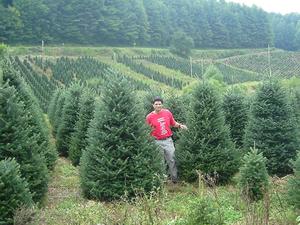
Nothing says Christmas more than a real Christmas tree!
Did you know that...
- Another tree is planted for each tree harvested
- Trees are environmentally friendly, provide habitat for wildlife, produce oxygen & are recyclable
- Christmas trees are professionally grown on a family farm
- You are supporting an American farmer
- And thank you for supporting a small local business!
Balsam Fir
The Balsam Fir is a beautiful dark-green color with airy, flexible branches that may not be able to hold heavy ornaments.The needles are 3/4" to 1 1/2" short, flat, long lasting needles that are rounded at the tip; nice, dark green color with silvery cast. It has an attractive form, it holds its needles well, and gives off a pleasant fragrance for your home. Named for the balsam or resin found in blisters on bark. Resin is used to make microscope slides and was sold like chewing gum; used to treat wounds in Civil War.
Big John's Balsam Firs come from New Brunswick, Canada.
Canaan Fir
Canaan (pronounced "Ka-naan", with emphasis on the last syllable) is a relative newcomer to the Christmas tree market. It has many similarities to both Fraser and Balsam Firs in growth and appearance.
Big John's Canaan Firs come from North Carolina and occasionally Pennsylvania.
Douglas Fir
The inch-long needles are thin, pointed, and soft; they grow in two rows, as on the balsam, and stick out in different directions, giving the tree a beautiful, feathery appearance. Douglas firs are dark green or blue green, depending on their genetic makeup and the type of soil they were grown in. Douglas fir are liked for their dense bushy shape and fine soft green needles. They have a distinctive pine-like scent, and that fragrance seems to last through the entire Christmas season. Easily decorated, Douglas fir is able to support a large number of Christmas tree lights if you really like to light it up!
Big John's Douglas Firs come from Pennsylvania and West Virginia.
Fraser Fir
This tree has become a Christmas favorite in recent years, thanks to the pretty contrast between the silver on the underside of the needles and the dark green on top. No worries about being pricked - the three-quarters-inch-long needles are flat, have blunt ends, and are soft to the touch. The Fraser Fir is said to have the best needle retention of all the trees, but farmers say needle retention is based more on how well you care for the tree. The Fraser Fir was named for a botanist, John Fraser, who explored the southern Appalachians in the late 1700's.
Big John's Fraser Firs come from North Carolina, Pennsylvania, West Virginia, Virginia and Michigan.
Noble Fir
Nobles are native to the Siskiyou Mountains of northern California and the Cascade and Coastal ranges of Oregon and Washington. It closely resembles the California red fir (Abies magnifica var. magnifica), commonly used as an uncultured tree called "silver tips" in the California fresh tree market, and the shasta fir (Abies magnifica var. shastensis) that is grown in some Pacific Northwest Christmas tree plantations. It grows in middle- to upper-elevation coniferous forests and is often associated with Abies amabilis (or "silver fir") and other conifers. The best stands are found in moist, middle elevation areas with deep, rich soils. Middle-elevation stands are usually more open than low-elevation forests and occur on poorer, thinner, rockier soils in areas more frequently disturbed by wind, snow and sometimes fire. In the wild, the trees are tall, beautifully symmetrical and grow to over 200 feet in height. The bark is smooth with resin blisters when young and changes to brownish-gray plates with age. The needles are roughly 4-sided (similar to spruce), over 1 inch long, bluish-green but appearing silver because of 2 white rows of stomata on the underside and 1-2 rows on the upper surface. The needles are generally twisted upward so that the lower surface of branches are exposed.
Big John's Noble Firs come from Washington.
Nordmann Fir
Nordmann or Caucasian Fir, is probably the handsomest of all in the Abies genera. Originating in the Caucasus Mountains of Asia Minor, this evergreen beauty may attain heights of 200 feet or more in the wild. Under cultivation, Nordmann Fir may grow up to 60 feet tall with a spread of approximately 25 to 30 feet. The flattened, soft, black green needles, 2 mm wide by 0.5 mm thick and glossy dark are borne on symmetrically arranged branches exhibiting a perfectly pyramidal specimen evergreen.
Big John's Nordmann Firs come from Washington, North Carolina and Pennsylvania.
Silvertip
The Silver Tip Christmas Tree features an open, airy shape with wide spacing between its branches and rich blue-green needles tipped with frosty silver-white new growth. Its exceptionally strong branches hold heavy ornaments beautifully, while its subtle fragrance makes it a lovely choice for those sensitive to strong scents. Native to the high mountains of California and Oregon, the Silver Tip is known for its excellent needle retention and long-lasting beauty throughout the holiday season.
Big John's Silver Tips come from Oregon.